
Nearby-airport comparison guide
Compare nearby airports for the same trip dates
Use Aviunion Flight Search to compare exact-date round trips across several practical departure and destination airports, then judge the flight together with the ground journey at both ends.
Start an exact-date searchDefine “nearby” by access, not by map distance alone
A nearby airport is useful only when you can reach it reliably. Start with the airports that fit your actual departure-day plan and repeat the exercise at the destination. A smaller airport may be closer to the final address, while a larger airport may offer more schedules or easier recovery options.
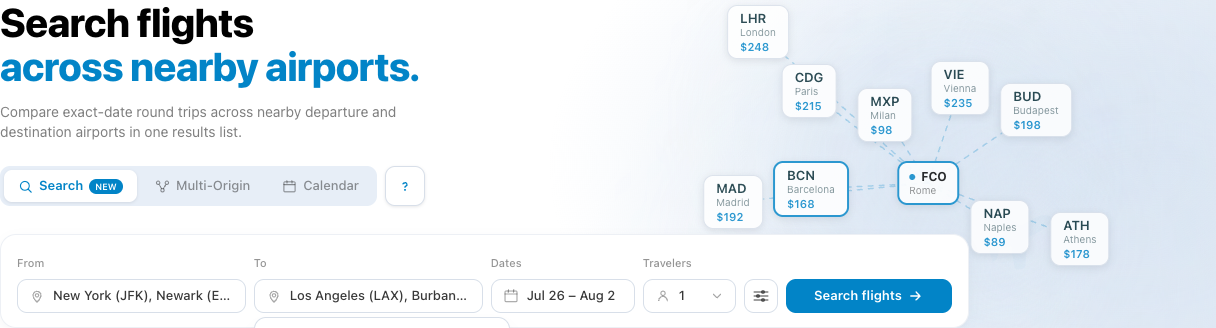
For example, a New York-area traveler might reasonably compare JFK and Newark, while a Los Angeles-area trip might include LAX and Burbank. Two origins and two destinations create four route pairings in one search. Aviunion supports up to five departure airports and five destination airports, up to 25 pairings, but adding every airport you recognize can make the decision noisier rather than better.
- Estimate door-to-airport travel under the traffic or transit conditions expected for that day.
- Include parking, tolls, rideshare, rail, or rental-car costs in your personal comparison.
- Exclude airports that require an unrealistic departure time or an unreliable transfer.
Let one search build the route matrix
Choose exact departure and return dates, add the practical airports on each side, and submit one Flight Search. Aviunion requests the route pairings and combines successful options into a single journey. If a requested pairing has no returned flights, the other successful routes can still remain available for comparison.
This is different from Multi-Origin Search. Nearby-airport Search plans one traveler’s fixed trip across several airport combinations. Multi-Origin Search starts with two travelers in different cities and helps them choose a shared destination. Calendar Search is the better tool when the airports are known but the travel dates are flexible.
Read the combined results without losing the route
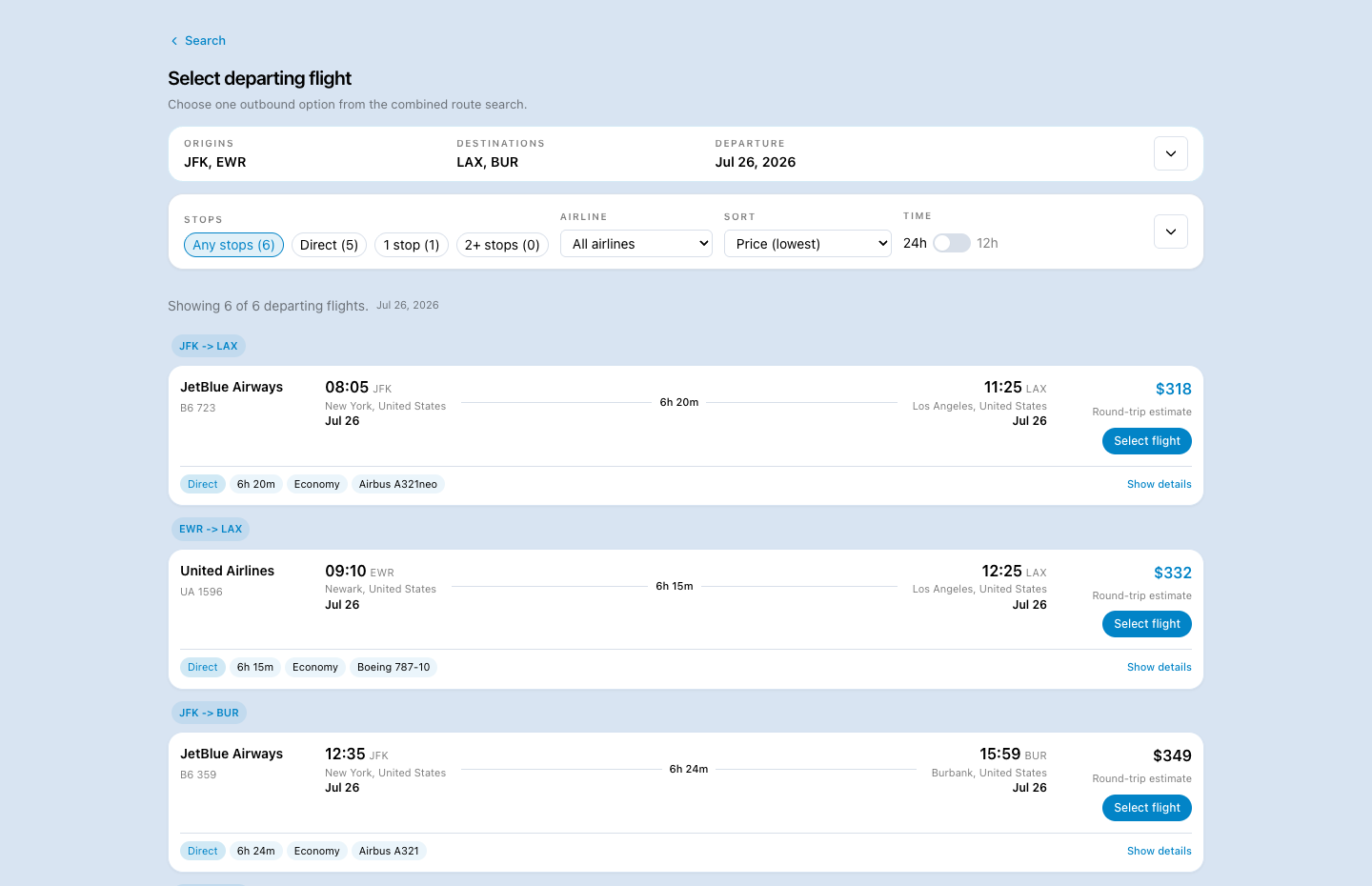
The results summary keeps the selected origin airports, destination airports, and date visible. Each flight card is labeled with its route pair, so a low price from one airport does not become detached from the extra trip required to reach that airport.
Use the shared controls to filter by stops or airline and to sort the returned flights. Advanced filters can narrow price, duration, layovers, departure time, or arrival time. Filtering the combined list is usually faster than opening a separate tab for each pairing, but the route label remains essential when you compare the tradeoff.
Compare the door-to-door trip, not only the fare
Aviunion compares the flight options it receives; it does not calculate your parking bill, train fare, hotel night, missed-work cost, or the value of an easier connection. Add those factors yourself before deciding that a nearby airport is cheaper or faster.
Scroll horizontally to compare every column.
| Cost or constraint | Include | Why it can change the choice |
|---|---|---|
| Ground transportation | Fuel, tolls, parking, rail, rideshare, or rental car | A lower flight price can disappear after airport-access costs. |
| Door-to-door time | Travel to the airport, security buffer, flight time, layovers, and final transfer | A shorter flight may still produce a longer total trip. |
| Schedule quality | Departure time, arrival time, and the return schedule | An inconvenient time can add a hotel night or remove useful time. |
| Connection risk | Stops, layover length, and realistic recovery options | A route with more alternatives may be worth a modest premium. |
| Fare conditions | Baggage, seat, change, cancellation, and provider fees | The displayed amount may not be the final trip total. |
Use a short checklist before selecting a flight
First, remove any airport you would not actually use. Then compare the best remaining flight from each route rather than comparing one attractive card with an entire airport. This keeps the decision fair and makes hidden ground costs easier to notice.
- Confirm the route label and airport codes on the flight card.
- Compare at least one viable option from every practical airport pairing.
- Check both the departing and returning journeys; the best outbound airport may have a poor return.
- Add the access cost and time at both ends of the trip.
- Prefer the itinerary that fits the whole trip, even when it is not the first result after sorting by price.
Verify the provider’s final itinerary and price
Aviunion does not sell tickets. The airline or travel provider confirms availability, the final total, passenger information, baggage and fare rules, payment, and post-booking support. Search results are planning signals and can change between the comparison and the provider page.
Before paying, verify the departure and arrival airport codes, both dates, local times, operating carrier, connection airports, baggage allowance, and final total. If the alternate airport is still the better choice after those checks and the ground journey, then the nearby-airport comparison has done its job.
If two people are departing from different cities and the destination is not fixed, switch to the related multi-origin guide below. That workflow compares the impact on both travelers rather than expanding the airport choices for one known trip.
Ready to search?
Put this guide into practice
Open Aviunion with Flight Search already selected.